
Berkshire County Divorce Decree Records
Berkshire County divorce decree records are held at the Probate and Family Court in Pittsfield, Massachusetts. The court handles all divorce filings, stores the official case files, and provides certified copies of judgments to those who need them. If you are searching for a divorce decree from Berkshire County, this guide covers where to look, how to request records, and what to expect from the process at the local court.
Berkshire County Overview
Berkshire County Probate and Family Court
The Berkshire Probate and Family Court is the official keeper of divorce decree records in the county. It sits at 44 Bank Row in Pittsfield and serves all of western Massachusetts's westernmost county. Staff at the Register of Probate office can help you locate case files, explain what records are available, and process requests for certified copies. The court covers divorces filed by Pittsfield residents, those from North Adams, Great Barrington, and every other town in the county.
The mass.gov Berkshire Probate Court page lists current office hours, contact details, and directions to the courthouse. Reviewing that page before your visit can save you a trip if hours have changed. The court also has a nearby Court Service Center at 76 East Street in Pittsfield, phone (413) 442-5910, where staff assist self-represented filers with forms and general questions.
The Massachusetts official page for the Berkshire Probate and Family Court shows contact information and services available to the public for divorce decree records.
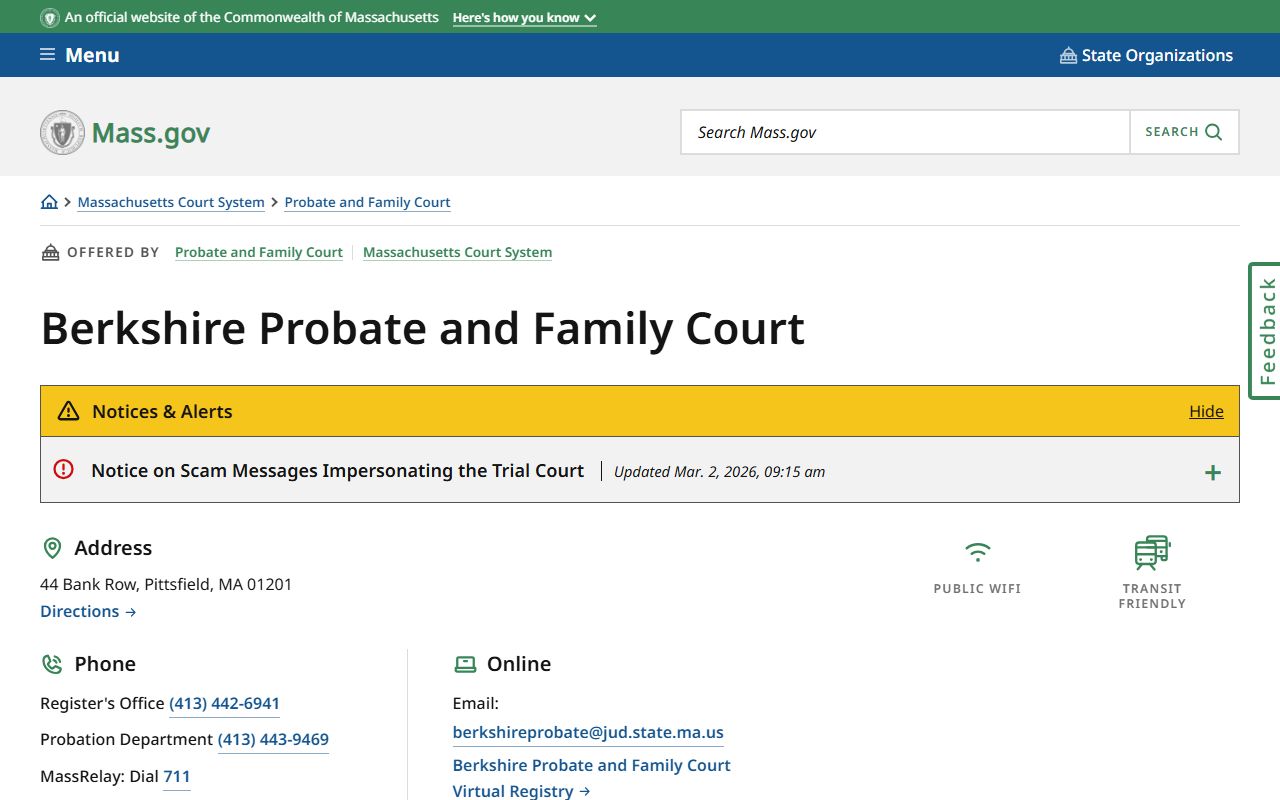
If you plan to visit in person, note that the court is open Monday through Friday and handles walk-in records requests during normal business hours.
| Court | Berkshire County Probate and Family Court |
|---|---|
| Address | 44 Bank Row Pittsfield, MA 01201 |
| Phone | (413) 442-6941 |
| Fax | (413) 443-3430 |
| berkshireprobate@jud.state.ma.us | |
| Hours | Monday through Friday, 8:45 AM to 4:30 PM |
How to Find Berkshire County Divorce Records
You have a few good options for searching Berkshire County divorce decree records. The fastest starting point is the free online portal at masscourts.org. This statewide system lets you search by name or case number. It shows party names, docket entries, and case status for most Probate and Family Court cases. Keep in mind that it shows docket information only. The actual documents, including the full divorce decree, are not viewable online. You need to contact the court directly for copies.
For in-person searches, go to 44 Bank Row in Pittsfield during court hours. Bring the full name of at least one spouse and the approximate year the divorce was filed. Staff can search by name or case number. If you have the docket number from masscourts.org, the in-person search is faster. The Register of Probate office handles all copy requests. Plain copies and certified copies are both available. Most people who need a divorce decree for legal purposes, like remarrying or updating a name, need the certified version.
This resource can help you narrow down a case before visiting the courthouse or submitting a mail request.
Mail requests also work for Berkshire County divorce decrees. Send a written request with the names of both spouses, the approximate filing year, and your daytime contact info to the Pittsfield address. Include payment by money order or bank check. Plain text requests work fine. You do not need a special form to ask for copies by mail, though filling out PFC Form 18 helps speed up the process.
Historic Berkshire Divorce Decree Records
Berkshire County has some of the oldest divorce records in the state. The original indexes, dockets, and case records from 1761 through 1865 are stored at the Massachusetts Judicial Archives in Boston. If you are researching a divorce that happened before the Civil War era, you will need to contact the Archives rather than the Pittsfield courthouse. Records after 1865 stay at the county courthouse.
There is an important gap to know about. Berkshire County divorce file papers have never been microfilmed or digitized. This means older records exist only on paper. The courthouse holds paper records for post-1865 cases. Historic divorce docket books from 1888 through 1927 are held in the Archives Reading Room in Boston. If you need anything from that period, a trip to the Archives or a written request may be needed.
Knowing which archive holds the record you need will save time before you make the trip or submit a formal request.
The Berkshire Law Library is inside the courthouse at 44 Bank Row. It is a public resource and can help people research statutes, look up case law, and understand divorce proceedings. Librarians do not give legal advice, but they can point you to the right materials. This is a good resource if you are not sure how the process works or want to read the actual law before filing.
Berkshire County Divorce Decree Fees
Fees for divorce filings in Berkshire County follow the statewide schedule set by the Massachusetts Trial Court. All Probate and Family Court locations charge the same amounts. The type of divorce you file determines the base fee. A joint petition under M.G.L. c. 208, § 1A costs $215 plus a $15 surcharge. A contested complaint under § 1B costs $280 plus the same surcharge. These are the fees to start the case, not including any costs for service, motions, or hearings.
Getting a certified copy of the divorce decree costs $20 per copy. You pay this fee at the Register of Probate office when you request the copy. The court accepts money orders and bank checks. Personal checks are not accepted for most transactions. The full fee schedule is posted at mass.gov.
People with low income can apply for a fee waiver by filing an Affidavit of Indigency with the court. The judge reviews the request. If approved, some or all fees may be waived.
Note: If you are not sure which type of divorce applies to your situation, the Court Service Center at 76 East Street, Pittsfield can help you identify the right forms and explain the differences.
Filing for Divorce in Berkshire County
Divorce in Massachusetts is governed by M.G.L. Chapter 208. To file in Berkshire County, you or your spouse must live in the county. If the grounds for the divorce arose outside Massachusetts, at least one spouse must have lived in the state for one year before filing. This residency requirement comes from § 5 of that chapter. If the grounds arose in Massachusetts, there is no minimum residency wait.
There are two paths for a no-fault divorce in Berkshire County. A joint petition under § 1A works when both spouses agree on all terms. You file together with a signed separation agreement covering property, support, and any children. The court schedules a brief hearing. After that, a 120-day nisi period runs before the divorce becomes absolute. The other option is a § 1B complaint, where one spouse files alone. That path has a 90-day nisi period after judgment. Most Berkshire County cases use one of these two options.
Nisi Period: A Berkshire County divorce is not final right away. After the judge enters the judgment nisi, joint petition cases wait 120 days and contested cases wait 90 days before the divorce becomes absolute.
All official divorce forms are free and available online at mass.gov or in person at the courthouse and Court Service Center. You can also file electronically through eFileMA for qualifying case types. When dividing assets, the court applies the factors listed in § 34, which guides how property is split in contested cases.
What Berkshire Divorce Decree Records Include
A divorce decree from Berkshire County contains the court's final ruling on the marriage. It states that the marriage is ended and sets out all the terms the court approved or ordered. This includes property division, debt responsibility, alimony if any was ordered, custody and visitation for any children, and child support amounts. The decree is signed by the judge and entered into the court record. It is the document you need to prove your divorce is final.
The full case file includes more than just the decree. It also has the original complaint or joint petition, financial statements from both parties, any separation agreement filed with the court, orders entered during the case, and transcripts if a hearing was held. Most of these documents are public record. Some financial details and information about children may have limited access under court rules. The Massachusetts Probate and Family Court sets the access rules for all county courts statewide.
You do not need to be a party to the case to request copies. Any member of the public can ask for a divorce decree from Berkshire County as long as the case is in the public record. Attorneys, researchers, and individuals all have the same basic access rights.
Legal Resources in Berkshire County
If you need help with a divorce case in Berkshire County, Community Legal Aid serves western Massachusetts. They offer free legal help to people who qualify based on income. Their main contact number for western Massachusetts is (413) 584-4034. They handle family law cases including divorce, custody, and support matters. Their broader resources are also accessible through MassLegalHelp.org, which has step-by-step guides and free forms for people who file without a lawyer.
The Massachusetts Bar Association also runs a lawyer referral service. Call (617) 654-0400 or toll-free at (866) 627-7577 to get matched with a local family law attorney. The first consultation is offered at a set low rate. If you have general questions about forms or the process, the Court Service Center at 76 East Street in Pittsfield is a walk-in resource staffed to help self-represented people navigate the system. They cannot give legal advice, but they can explain what forms to use and how to file them.
Note: The Berkshire Law Library inside the courthouse at 44 Bank Row is open to the public and has legal texts, statutes, and self-help resources for divorce cases.
Cities in Berkshire County
Berkshire County includes Pittsfield, North Adams, Great Barrington, and many other towns and communities across the western part of the state. None of the cities in Berkshire County meet the population threshold required for a dedicated city page on this site. All residents of Berkshire County, regardless of which town they live in, file divorce cases at the Berkshire County Probate and Family Court at 44 Bank Row in Pittsfield.
Nearby Counties
These counties are adjacent to Berkshire County. If you are not sure which county has jurisdiction over your divorce case, check the address where you or your spouse lives. Jurisdiction follows residence, not the location of the marriage.