
Find Massachusetts Divorce Records Online
Massachusetts divorce records are held at the Probate and Family Court in each of the state's 14 counties. Every divorce decree filed in Massachusetts goes through this court system. You can search for divorce case info online through the MassCourts portal or visit the courthouse in person to get certified copies of decrees, separation agreements, and other filings. The court clerk in each county keeps the full case file. Both joint petition and contested divorce records are public. Whether you need proof of a past divorce or want to look up case details, this page covers how to find and get Massachusetts divorce decree records from the right source.
Massachusetts Divorce Records Overview
Where to Find Massachusetts Divorce Records
The Probate and Family Court is the main source for divorce records in Massachusetts. Each of the 14 counties has its own Probate and Family Court division. These courts hold the full case files for every divorce filed in their county. The files include the complaint, the separation agreement, financial statements, and the judgment of divorce signed by the judge. The Register of Probate in each county keeps these records and can make copies for you.
Unlike some states, Massachusetts does not issue separate divorce certificates through its vital records office. The Registry of Vital Records and Statistics handles birth, death, and marriage records but not divorce. To get proof of a divorce in Massachusetts, you must contact the Probate and Family Court in the county where the case was heard. The court can give you a certified copy of the divorce judgment, which serves as your official proof.
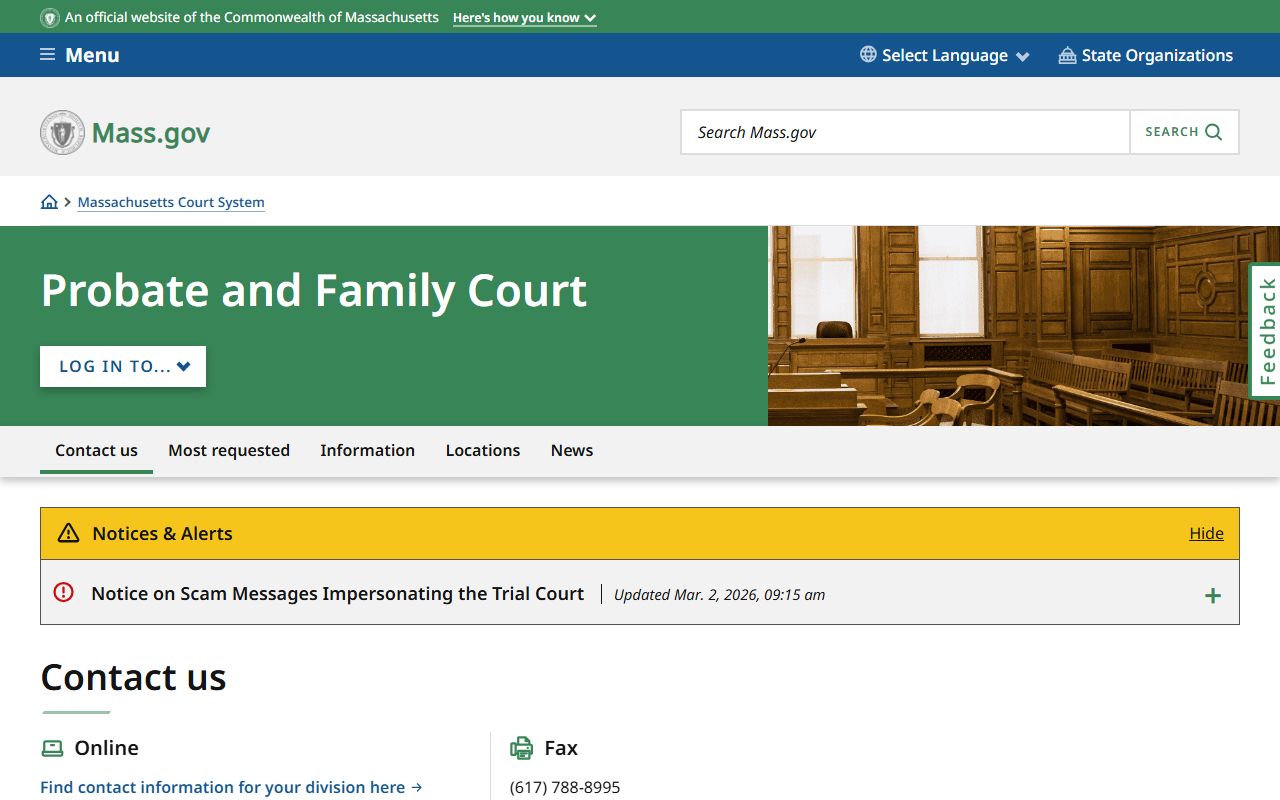
Note: For divorce records, go to the Probate and Family Court, not the Registry of Vital Records. The registry only handles birth, death, and marriage certificates in Massachusetts.
How to Search Divorce Records in Massachusetts
Massachusetts has a few ways to look up divorce records. Online search is the fastest for basic case info. In-person visits work best when you need certified copies or want to see the full case file. Both options are open to the public.
MassCourts is the state's online case lookup system. It covers all Probate and Family Court divisions across the 14 counties. You can search by name, case number, or case type. The system shows party names, docket entries, hearing dates, and case status. It is free to use. Keep in mind that Probate and Family Court records have some access limits online. Not all documents show up in the system. Visit masscourts.org to start your search.
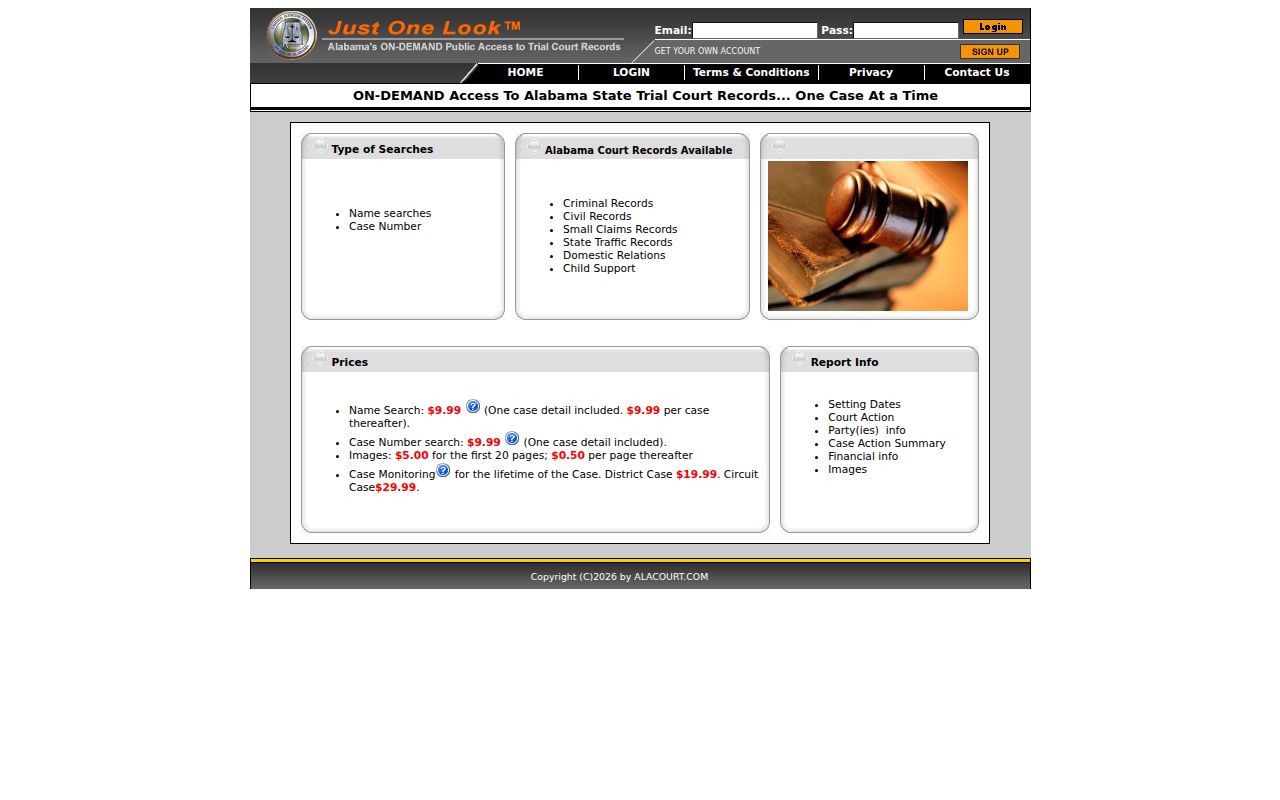
To search divorce records on MassCourts, you need:
- Full name of at least one spouse
- Approximate date of the divorce filing
- County where the case was filed
You can also search in person at any Probate and Family Court. Go to the county where the divorce was filed. Staff can help you find records and make copies. Certified copies cost more than plain ones. You can also file for divorce online through eFileMA.com, which is the state's electronic filing portal for all court types.
Types of Divorce Records in Massachusetts
Massachusetts divorce records include several types of documents. The judgment of divorce nisi is the court order that ends a marriage. It does not take effect right away. There is a waiting period called the nisi period before the divorce becomes final. For a joint petition (1A), the nisi period is 120 days. For a contested divorce (1B), the nisi period is 90 days. Only after this wait does the divorce become absolute.
The separation agreement is another key document. This lays out how the couple splits property, handles custody, and deals with support. Both spouses sign it in a joint petition case. In contested cases, the judge may set these terms after a hearing or trial. The separation agreement becomes part of the court file and is a public record.
Divorce records in Massachusetts typically contain the following:
- Full legal names of both spouses
- Date and place of the marriage
- Date the divorce was filed
- Date the judgment became absolute
- County and court where it was heard
- Grounds cited for the divorce
- Terms of property division
- Custody and support orders
Court case files may also hold motions, financial statements, and other papers filed during the case. These show the full history of the divorce proceedings. You can get copies of most papers in a case file from the Register of Probate.
Massachusetts Divorce Laws and Rules
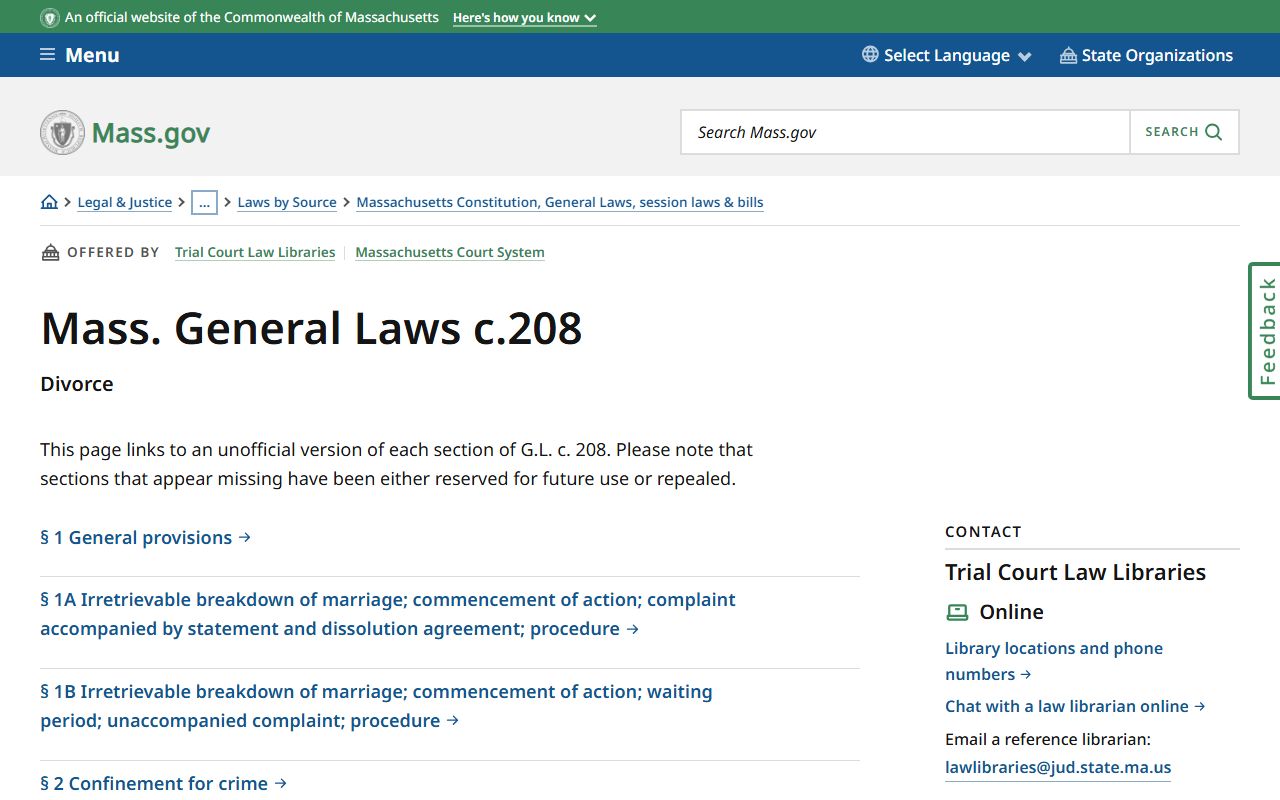
Massachusetts law sets the rules for getting a divorce. All divorce law is in Massachusetts General Laws Chapter 208. These laws cover residency, grounds, waiting periods, and property division. You must follow these rules to file for divorce in Massachusetts.
Under M.G.L. c. 208, § 5, at least one spouse must have lived in Massachusetts for one year before filing if the cause for divorce happened outside the state. If the grounds arose in Massachusetts, there is no minimum residency period as long as one spouse still lives here. You file in the county where one of you lives. If either spouse still lives in the county where you last lived together, you must file there.
Massachusetts allows both fault and no-fault divorces. The no-fault ground is "irretrievable breakdown of the marriage." Most divorces use this. There are two paths for no-fault cases. Under M.G.L. c. 208, § 1A, both spouses can file a joint petition with a signed separation agreement. Under M.G.L. c. 208, § 1B, one spouse can file alone when the other does not agree. Fault grounds under M.G.L. c. 208, § 1 include adultery, desertion, cruel and abusive treatment, and gross habits of intoxication.
Nisi Period: A Massachusetts divorce is not final right away. After the judge enters the judgment nisi, there is a waiting period. Joint petition (1A) cases wait 120 days. Contested (1B) cases wait 90 days. The divorce becomes absolute only after this nisi period ends.
The court may issue temporary orders for child custody, support, or use of the home while the case is pending. These stay in effect until the divorce is final.
Massachusetts is an equitable distribution state. Under M.G.L. c. 208, § 34, property is divided fairly but not always equally. The court looks at 15 factors including the length of the marriage, each spouse's income, age, health, and what each person put into the marriage. All property is subject to division in Massachusetts, including gifts, inheritances, and assets from before the marriage.
Divorce Filing Fees in Massachusetts
Fees depend on the type of divorce you file in Massachusetts. A joint petition for divorce (1A) costs $215. A complaint for divorce (1B) costs $280. There is also a $15 surcharge on top of the filing fee. A summons costs $5, and a citation costs $15. These fees apply at all 14 Probate and Family Court divisions across the state.
If you use the online filing system at eFileMA.com, there is an extra $22 case fee plus small processing fees for credit card or eCheck payment. Service by constable or sheriff costs about $50 to $75 on top of the court fees. Getting copies of existing divorce records has its own fees. Certified copies cost more than plain ones. Call the Register of Probate to ask about current copy costs.
Fee waivers are available for people with low income. You file an Affidavit of Indigency with the court. You must show proof that you cannot pay. The judge reviews your request and decides if you qualify. Forms are available at the courthouse or online at mass.gov.
Tip: Filing fees can change. Contact the Probate and Family Court or check mass.gov filing fees page to confirm current costs.
How to Get Copies of Massachusetts Divorce Records
To get copies of divorce records in Massachusetts, contact the Probate and Family Court in the county where the divorce was filed. You can visit in person or call ahead to check what you need. The Register of Probate can search records by name or case number and make copies for a fee. Certified copies cost more than plain ones.
You can also search for basic case info online through MassCourts at masscourts.org. This free tool shows docket entries and case status but may not have full document images. For the actual judgment of divorce or separation agreement, you will likely need to go to the courthouse or send a written request.
Wait times vary by court. In-person requests can often be handled the same day if the file is available. Mail requests may take a few weeks depending on the court's workload. Some courts accept requests by email or fax. Call the specific Probate and Family Court to ask about their process. Each county court has its own procedures for records requests.
Legal Help for Divorce in Massachusetts
Several groups offer help with divorce cases in Massachusetts. Greater Boston Legal Services gives free legal help to people with low income in the Boston area. Call (617) 371-1234 to ask about their services. Community Legal Aid serves Central and Western Massachusetts from Worcester. They handle family law cases for people who qualify based on income.
The Massachusetts Bar Association runs a lawyer referral service. Call (617) 654-0400 or toll-free at (866) 627-7577 to get matched with a family law attorney. The first meeting costs $25 for a half hour. They also run a free Dial-A-Lawyer program on the first Wednesday of every month. Call (617) 338-0610 for that service.
MassLegalHelp at masslegalhelp.org offers self-help guides and forms for people who want to file on their own. The site walks you through the divorce process step by step. You can also find all official court forms at mass.gov. The Massachusetts Legal Resource Finder at masslrf.org can help you find free or low-cost legal help based on your location and issue.
Are Divorce Records Public in Massachusetts
Yes, divorce records are generally public in Massachusetts. Court records are open to the public under the state's public records laws. You do not have to be one of the parties in the case. You do not need to give a reason for your request. Most of the file is available to anyone who asks at the Probate and Family Court.
Some limits apply to what you can see. Financial statements filed in divorce cases may have restricted access. Details about minor children are sometimes sealed or redacted. A party can ask the court to impound certain records if they show a strong reason. A judge decides whether to grant this request. Impounded records are not common in Massachusetts, but they do happen in cases with safety concerns or sensitive financial info.
Most divorce records at the Probate and Family Court are open to the public. Some financial details and info about children may have restricted access.
Browse Massachusetts Divorce Records by County
Each county in Massachusetts has its own Probate and Family Court that keeps divorce records. Pick a county below to find local contact info and resources for divorce records in that area.
Divorce Records in Major Massachusetts Cities
Residents of major cities file for divorce at their county's Probate and Family Court. Pick a city below to learn about divorce records in that area.